Job Search Automator.
Someone in my family was made redundant. So I built the system I said I'd build — the one that turns a demoralising daily slog into a twenty-minute review.
Someone close to me — senior finance, decades in — was made redundant, and spent a stretch out of a role. We talked about the market: how it works now, how much of the day disappears into searching, tailoring, and sending into silence. I’d been living inside Claude Code for months, building automations for everything, and I said what I actually believed — this is exactly what I’d build to fix it. I got them onto Claude Code for quick CV edits, and it helped. Then I stopped describing the system and made it.
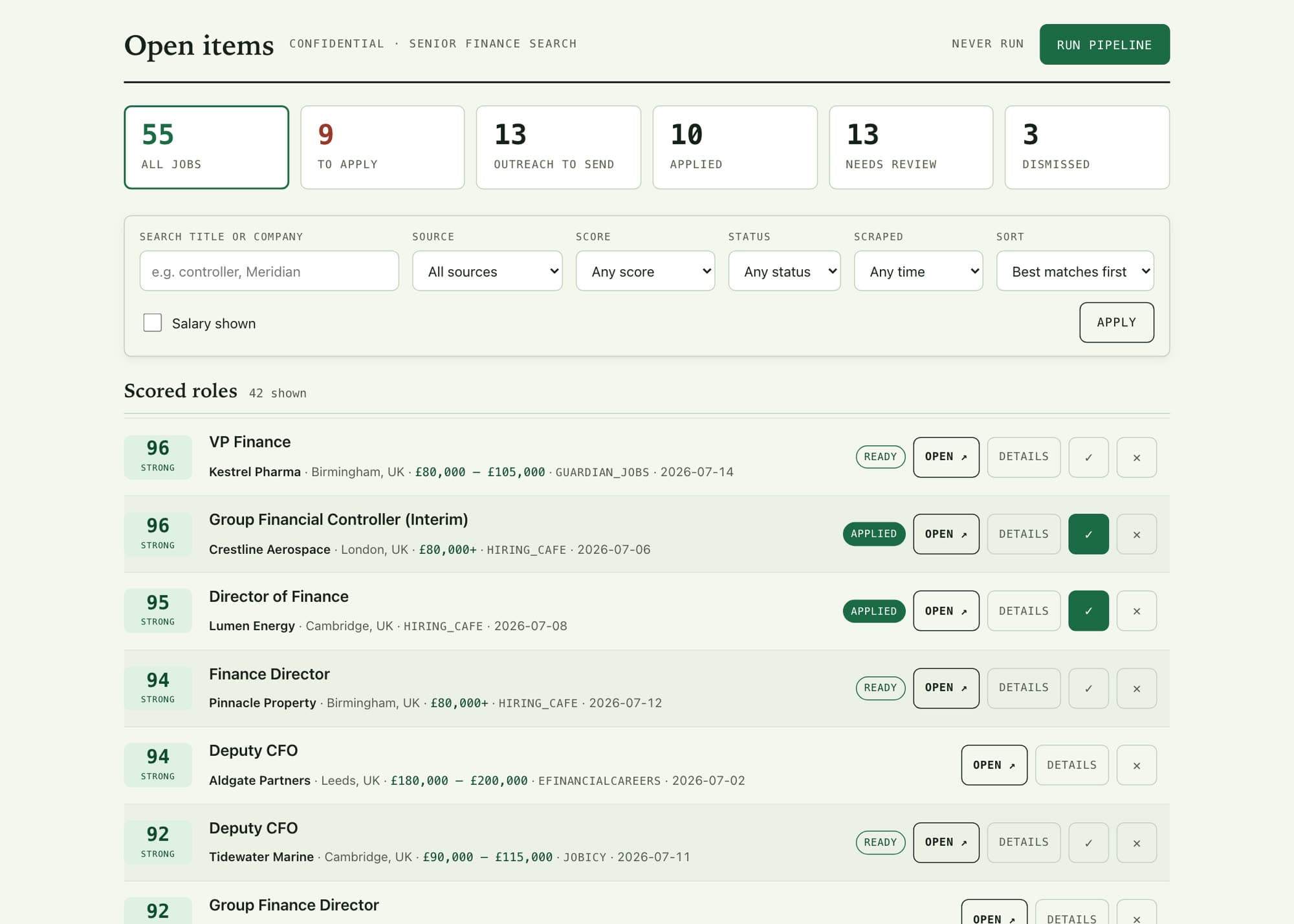
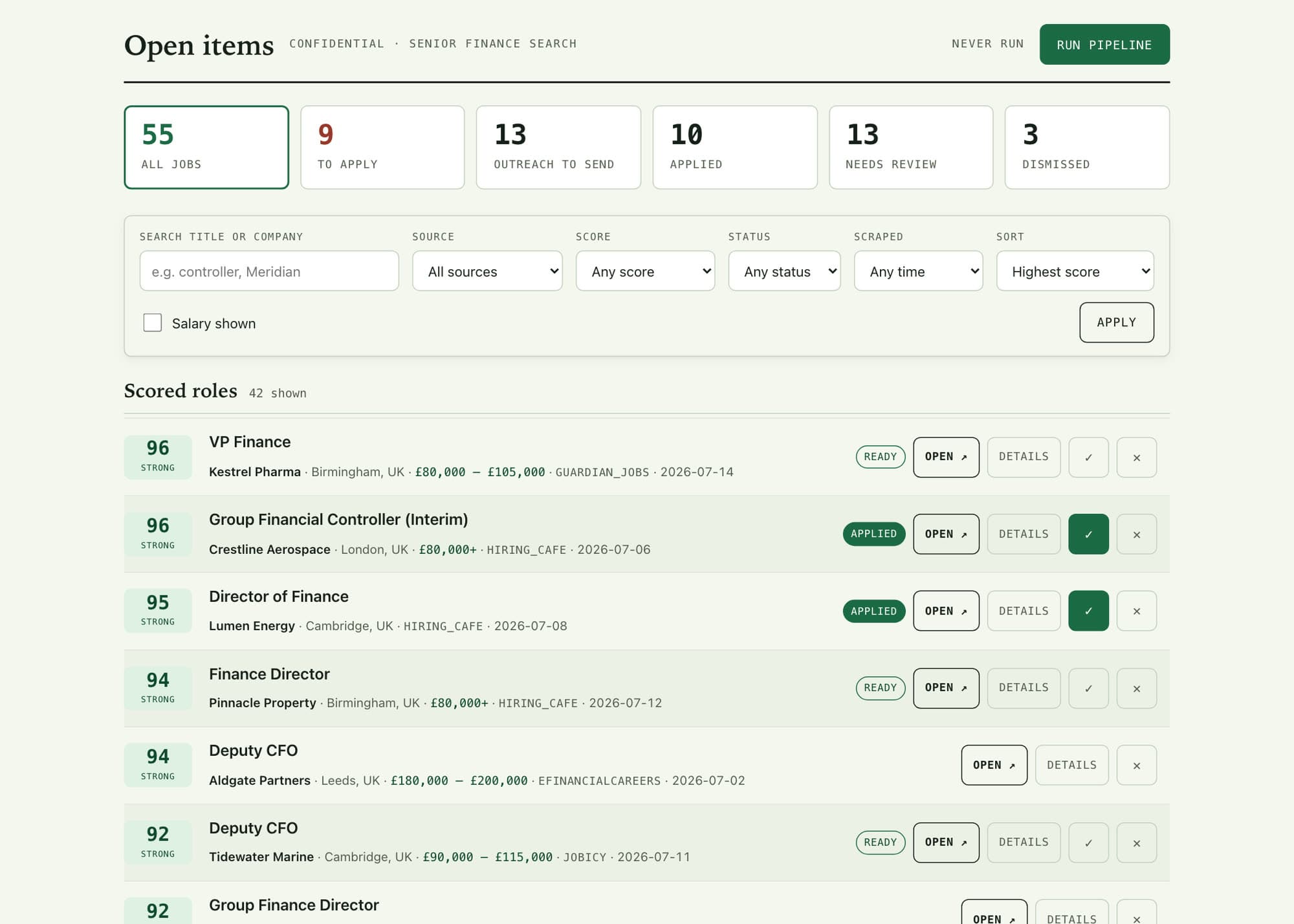
It runs once a day, on its own. For the first search that meant senior finance — CFO, Finance Director, Financial Controller — scraped across seven-plus job boards and scored 0–100 against the actual CV, so the day starts already sorted by fit. Everything clearing the bar gets a tailored CV and cover letter written to that specific role, and the top handful get a ready-to-send LinkedIn connection request and follow-up. A daily digest lands with the lot summarised. On top sits a dashboard to work the pipeline: scored roles, the workflow states — to apply, outreach to send, applied, dismissed — and one place to act.
What it deliberately doesn’t do is apply for you. It does the sifting and the first draft — the parts that are pure time — and leaves the judgment and the send to a person. It reads the boards and the candidate’s own materials, runs under their own accounts, and writes from their real CV, never inventing a line of it. The point isn’t to game anything. It’s to take the demoralising, hours-long grind of a modern job search and hand back most of the day — so the search is about the good conversations, not the admin.
It started as one person’s tool, then outgrew it. I pulled everything specific to them out of the code and into a profile — the CV, the target titles, the boards, the scoring rubric all live in config now — so standing up a new search is a short setup wizard and a CV file, not a rewrite. When a second family member needed the same help in a different field entirely, they got their own copy off the same engine: different titles, different boards, their own CV, not a line of code changed.
A couple of weeks to build the first one; an afternoon to point it at the next. The screens below are the running system, with personal details kept private. It’s the kind of software I like most: small, sharp, and quietly making someone’s week better — and, it turns out, more than one someone.